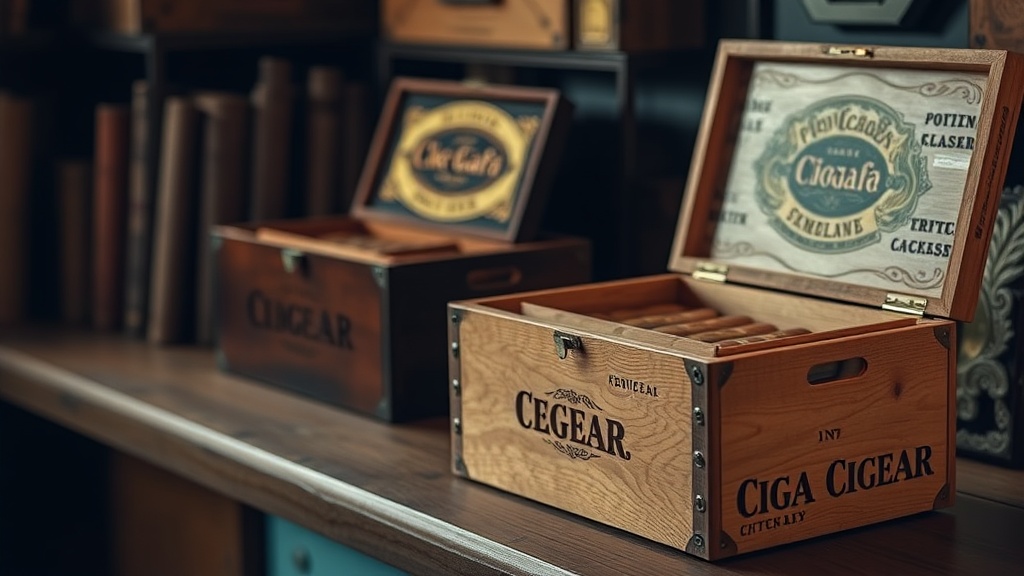
How to Identify and Value Vintage Wooden Cigar Boxes

This post covers the practical steps for identifying authentic vintage wooden cigar boxes and understanding what drives their market value. Whether you're sorting through an estate sale in Edmonton or bidding on a Heritage Auctions lot, you'll learn how to spot genuine period pieces, read maker's marks, and avoid overpaying for modern reproductions.
What Makes a Wooden Cigar Box "Vintage"?
A wooden cigar box becomes "vintage" once it crosses the 50-year threshold—typically pre-1970s—though many collectors stretch that definition to include boxes from the 1980s if they represent discontinued brands or special editions. The key isn't just age. It's the craftsmanship.
Boxes from the early 20th century were built from Spanish cedar, mahogany, or walnut. They smelled of tobacco resin and linseed oil, not synthetic varnish. You'll often find dovetail joints, brass hinges, and hand-applied paper labels rather than heat-stamped logos. Here's the thing: not every old box is valuable. A battered 1930s generic humidor might fetch $15, while a pristine Arturo Fuente cabinet from the same era could command $400 or more.
The transition period matters too. After the 1959 Cuban embargo, American manufacturers shifted to Dominican and Honduran tobacco. Boxes made before that shift—especially those marked "Habana" or "Hecho en Cuba"—carry extra weight with collectors who focus on pre-revolutionary Cuban heritage.
How Can You Tell If a Cigar Box Is Genuine and Not a Reproduction?
The fastest way to spot a fake is to examine the construction details and the aging patterns of the materials.
Reproductions often use machine-cut joints that look too uniform. Real vintage boxes show slight irregularities in the dovetails—wider at the front, tighter at the back. The wood inside should have a dull, oily patina from decades of tobacco exposure. If it smells like fresh pine or furniture polish, that's a red flag.
Look at the hinges. Period boxes typically used simple brass butt hinges with flathead screws. Modern reproductions favor nickel-plated piano hinges or Phillips-head fasteners. (Yes, screw heads matter—more than most beginners think.) The paper labels should also show foxing, edge wear, or soft creases. Labels that look laser-printed or too crisp are almost certainly new.
Worth noting: some reproductions are honest replicas sold as decorative items. The catch? Resellers on marketplace sites often pass them off as antiques. Always ask for photos of the interior, the base, and any tax stamps or revenue labels before committing to a purchase.
What Factors Determine the Value of a Vintage Wooden Cigar Box?
Value comes down to six core factors: brand, age, condition, rarity, provenance, and craftsmanship.
Brand recognition sits at the top. Boxes associated with legendary Cuban marques like Cohiba, Romeo y Julieta, Partagas, and H. Upmann consistently outperform no-name alternatives. That said, a beautifully crafted box from a defunct Tampa manufacturer like Ybor City's cigar heyday can surprise you at auction.
Age amplifies value only when the box survives intact. A 1920s cabinet with original hardware and labels rates far higher than a similar box that's been sanded, re-stained, or fitted with new hinges. Collectors call original condition "all-original" or "unmolested"—and they'll pay premiums for it.
Rarity follows special editions, commemorative releases, and boxes tied to historical events. The 1996 Cohiba 30th Anniversary humidor—produced in extremely limited numbers—remains one of the most sought-after modern pieces. On the flip side, mass-produced boxes from the 1950s (think machine-made brands sold in drugstores) are common. They're charming, but don't expect retirement money.
Provenance can transform a $50 box into a $500 box. A cigar box that belonged to Winston Churchill, or one documented in a specific Edwardian club in London, carries irreplaceable story value. Without paperwork or photographic evidence, though, provenance claims should be treated as friendly conversation starters—not facts.
Where Should You Look for Markings and Maker's Details?
The most informative markings hide on the underside of the lid, the interior base, and sometimes the back panel.
Start with the tax stamp. In the United States, cigar boxes carried federal revenue stamps from 1863 through the mid-20th century. These stamps indicate the box's official registration and often include a date. Canadian boxes used similar excise markings, though the color schemes and denominations differed. If a stamp is intact, you've got a solid anchor for dating.
Next, look for the manufacturer's label. Early Cuban exporters like Habanos S.A. predecessors often affixed ornate paper labels with embossed crests and bilingual text. American makers favored simpler paper strips or burnt-brand stamps directly into the wood. European boxes—particularly those from German or Dutch distributors—sometimes included metal plaques or printed fabric liners.
Don't ignore the hardware. Hinges from companies like "S.D. Myres" or "Ward & Payne" can help narrow down a production window. Even the nail patterns matter. Hand-forged nails with irregular heads suggest 19th-century construction. Wire nails with flat, uniform heads point to post-1890 manufacturing.
How Much Are Vintage Wooden Cigar Boxes Actually Worth?
Most vintage wooden cigar boxes sell between $25 and $300, with exceptional pieces crossing into the thousands.
The market splits roughly into three tiers. Entry-level collectors hunt for decorative boxes in the $20–$75 range—think 1940s American-brand cabinets with worn labels but solid bones. Mid-tier buyers target named Cuban or Dominican boxes from the 1950s–1970s in good condition, usually spending $100–$400. The high end is dominated by limited-edition humidors, celebrity-provenance pieces, and pre-embargo Cuban cabinets, which regularly hit $1,000–$5,000 at specialty auctions.
| Box Type | Typical Era | Condition | Estimated Value (CAD) |
|---|---|---|---|
| Generic American-brand cabinet | 1930s–1950s | Fair, some label wear | $25 – $75 |
| Cuban-export branded box (Romeo y Julieta, Partagas) | Pre-1960 | Good, original hardware | $150 – $450 |
| Limited-edition commemorative humidor | 1980s–2000s | Excellent, with documentation | $500 – $2,500 |
| Provenance-documented celebrity or historical box | Any era | Variable | $1,000+ |
These ranges shift with collector trends. A decade ago, nobody cared about 1980s Davidoff boxes. Now? They're heating up. The same goes for Canadian-market cabinets from the 1960s—once overlooked, now gaining traction among regional collectors in Alberta and British Columbia.
Should You Restore a Vintage Cigar Box or Leave It Alone?
In nearly every case, you should leave the original finish, labels, and hardware intact.
Restoration seems tempting when a box arrives with water stains, loose hinges, or torn paper. The reality is that collectors value originality over perfection. A faded label with 80% coverage beats a reproduction label every time. A slightly loose hinge is preferable to a shiny new brass replacement that throws off the visual period.
That said, stabilization is different from restoration. You can gently clean grime with a soft cloth and distilled water. You can re-glue a separating joint with hide glue (which remains reversible). You can stabilize flaking paper labels with archival wheat-starch paste. What you shouldn't do is sand, stain, varnish, or re-line the interior with modern cedar. Those changes permanently alter the object—and slash the resale value.
If a box is meant purely for display in your home and you've got no plans to sell, a light waxing with Briwax Original won't offend anyone. Just don't expect the collector community to celebrate it. The unwritten rule is simple: preserve what survived, and resist the urge to "improve" it.
Tips for Buying Smart
When hunting for vintage wooden cigar boxes, patience pays. Estate sales in older Edmonton neighborhoods like Garneau or Old Strathcona occasionally turn up boxes from immigrants who brought their smoking traditions from Europe. Flea markets in smaller Alberta towns—think Camrose or Leduc—can yield surprises that big-city dealers missed.
Online, use specific search terms. "Wooden cigar box," "vintage humidor," and "antique tobacco cabinet" each pull different inventory. Set alerts for individual brands if you're building a focused collection. And always factor shipping into your budget—wooden boxes are heavier than they look, and a $30 purchase can balloon once cross-border freight enters the equation.
Authentication isn't instant. It takes practice, comparison, and a willingness to handle hundreds of boxes before the good ones start jumping out. Keep a magnifying glass in your bag. Photograph the markings. Cross-reference maker's names with period directories. The learning curve is steep, but for collectors who love the intersection of craft and history, there's no better corner of the paper-and-print world to explore.