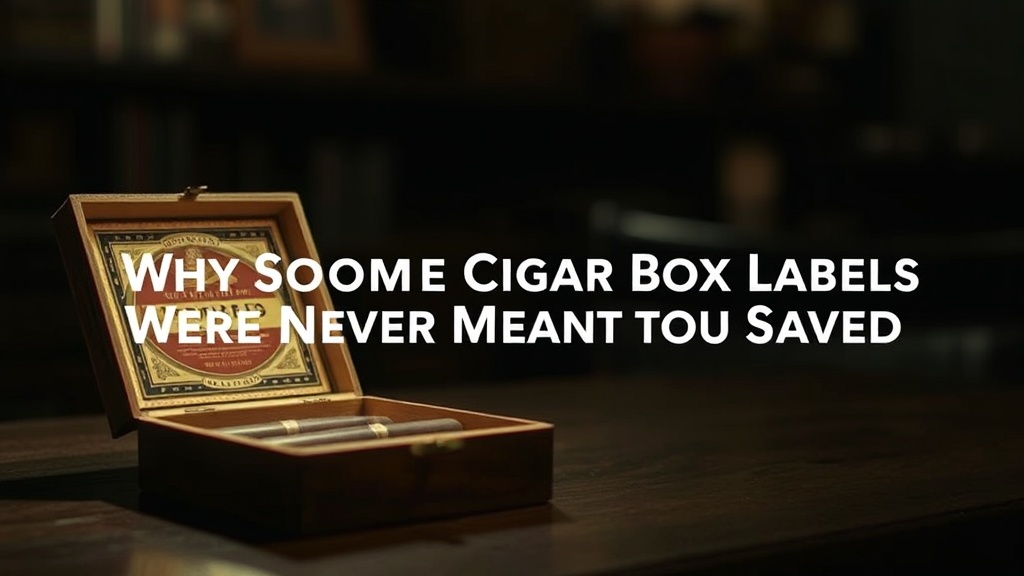
Why Some Cigar Box Labels Were Never Meant to Be Saved

Between 1870 and 1920, American lithography houses produced over four billion cigar box labels—and nearly every single one was designed to be thrown away. These vibrant, embossed pieces of commercial art weren't created for collectors. They were marketing tools meant to catch a smoker's eye, sell the product, and ultimately end up in the trash. That so many survived is a small miracle of happenstance—and it's precisely why the collector's market for these paper fragments remains so unpredictable today.
This post explores the disposable origins of cigar box labels, why their survival defies the intentions of their creators, and what collectors should know about authenticating and valuing these accidental artifacts.
Why Were Cigar Box Labels Designed to Be Temporary?
The economics of the cigar industry in the late 19th century made label permanence impractical—if not impossible. Most cigar manufacturers operated on thin margins, churning out boxes by the thousands to satisfy America's insatiable appetite for tobacco. A typical factory might release fifty different label designs annually, each tied to specific promotions, seasonal blends, or regional markets.
Labels served a strictly utilitarian purpose. They identified the brand, signaled quality through elaborate artwork, and distinguished one wooden box from another on crowded general store shelves. Once the cigars sold, the box—and its decorative label—had fulfilled its function. Shopkeepers routinely stripped old labels from returned boxes, applied new ones, and sent the containers back into circulation. The paper itself was never meant to outlast the product inside.
This disposable mindset shaped everything about label production. Lithographers used acidic papers and vegetable-based inks because they were cheap and fast. No one worried about archival quality because nobody expected these items to be archived. The vibrant chromolithographed images that dazzle collectors today were, to their creators, essentially packaging waste—beautiful, yes, but ultimately destined for the same fate as yesterday's newspaper.
The irony isn't lost on modern collectors. We treasure precisely what was designed to be discarded. A pristine 1890s label depicting a tropical scene or a dignified statesman exists not because anyone valued it at the time, but because someone—somewhere—neglected to follow the intended disposal protocol.
How Did Any Cigar Box Labels Survive at All?
The survival of these paper fragments required specific, often accidental, conditions. Understanding those conditions helps collectors assess authenticity and condition when evaluating potential purchases.
Printer's archives account for a significant portion of extant labels. Lithography houses like Lorillard, Knapp & Company and George S. Harris & Sons maintained sample books showing clients their capabilities. These bound volumes preserved thousands of designs that would otherwise have vanished. When digital photography rendered sample books obsolete in the mid-20th century, many were broken up and sold to collectors—a transfer that saved the labels while destroying their original context.
Unsold inventory represents another major source. Cigar manufacturers routinely overestimated demand, leaving warehouses full of unused labels when brands failed or fashions changed. These "dead stock" caches occasionally surface when old buildings are demolished, yielding dozens—or hundreds—of identical labels in mint condition. Such finds depress prices temporarily but provide collectors with affordable entry points into the hobby.
Personal hoarding—though rare—produced some of the most interesting survivals. Factory workers occasionally saved favorite designs. Salesmen kept samples for reference. Children clipped images for scrapbooks (a popular Victorian pastime). These individually preserved pieces often show handling wear, paste residue, or scissor marks that testify to their unofficial survival.
Climate played its role too. Labels stored in dry, stable environments—attics in the American Southwest, for instance—fared better than those subjected to humid summers and freezing winters. The National Archives' preservation guidelines for paper ephemera emphasize that temperature and humidity fluctuations cause more damage than age itself. A label tucked into a ledger in arid Arizona might emerge a century later looking freshly printed, while its Vermont counterpart crumbled to fragments.
What Should Collectors Look for in Authentic Labels?
The accidental nature of label survival creates specific authentication challenges. Unlike postage stamps or currency, cigar box labels weren't serialized or officially recorded. Provenance is often murky, and reproductions—both contemporary and modern—circulate in the marketplace.
Paper characteristics offer the most reliable authentication clues. Period labels (roughly 1860–1930) used wood-pulp paper with visible fiber irregularities. Hold a suspected vintage label to light and you should see uneven thickness, occasional specks, and slightly ragged edges. Modern reproductions typically employ uniform, bright-white stock that looks too perfect under examination.
Printing methods evolved significantly during the golden age of cigar labels. Early examples (pre-1880) show the flat, slightly matte appearance of stone lithography. Later pieces feature the raised, tactile quality of chromolithography with its multiple color layers. By the 1910s, offset printing and cheaper halftone processes dominated, producing flatter images with less visual depth. A label purporting to be from 1890 but printed with halftone dots is either misdated or inauthentic.
Gum patterns on the reverse side reveal how labels were applied. Original labels intended for box application carried hide glue or wheat paste adhesive, often applied in characteristic patterns—stripes, dots, or full coverage depending on the manufacturer. Labels from sample books typically lack adhesive entirely or show evidence of having been pasted into albums. Modern reproductions sometimes feature self-adhesive backing that didn't exist until the 1960s.
The Duke University's Rare Book, Manuscript, and Special Collections Library maintains an extensive archive of tobacco advertising materials including original production records that can help verify specific label designs and date ranges. Serious collectors consult these resources before major purchases.
Does the Disposable Origin Affect Value?
The ephemeral nature of cigar box labels creates a fascinating valuation paradox. Items never intended to survive often command higher prices precisely because their survival was unlikely—yet common designs remain affordable because so many copies accidentally persisted.
Rarity in this market follows unpredictable patterns. A stunningly beautiful label from a major brand might sell for $20 because thousands were preserved in a printer's archive. A crude, amateurish design from a short-lived regional manufacturer might fetch $200 because only two examples survived the decades. Collectors must resist the assumption that aesthetic quality correlates with monetary value.
Condition matters enormously. Since these items weren't valued historically, most survivals show damage—tears, stains, adhesive residue, or fading. Truly pristine examples command substantial premiums, sometimes ten or twenty times the price of merely "good" copies. The disposable origin actually helps here: because labels weren't cherished heirlooms, examples in mint condition usually indicate proper storage from the moment of production—suggesting authentic, unaltered specimens.
The market has evolved considerably since serious collecting began in the 1960s. Early enthusiasts focused on visual appeal, amassing colorful displays without concern for historical context. Contemporary collectors increasingly value documentation—knowing which factory produced a label, when, and for what market. This shift rewards research and punishes the uninformed. A labeled identified through archival research sells for multiples of an identical but unattributed example.
Tips for New Collectors Starting Out
If you're entering this field, start with common, affordable labels to train your eye. Learn to distinguish lithographic printing from later methods. Handle enough examples to recognize period paper stock by touch. Build relationships with established dealers who guarantee authenticity—and learn from their expertise before attempting significant independent purchases.
Focus your collection around a specific theme rather than buying randomly. Some collectors pursue labels depicting animals; others collect only brands from a particular state; still others specialize in "inner labels" (the smaller decorations that lined box interiors) versus the more common outer labels. Thematic focus helps you develop deeper knowledge than scattershot acquisition.
Store your growing collection properly—ironic given that these items survived precisely because someone ignored them. Use acid-free sleeves, maintain stable humidity between 45% and 55%, and keep labels flat under moderate pressure to prevent curling. You're no longer treating them as disposable packaging; you're preserving commercial art that escaped its intended fate.
The next time you hold a colorful cigar label, remember: you're touching something that wasn't supposed to exist. Every surviving example represents a small act of preservation against the grain of history—a moment when someone looked at packaging waste and saw something worth keeping. That transformation—from trash to treasure—remains the fundamental story of this peculiar collecting field.